
Why Startups Prefer Freelance Full Stack Developers Over Agencies
5 min
Freelancing
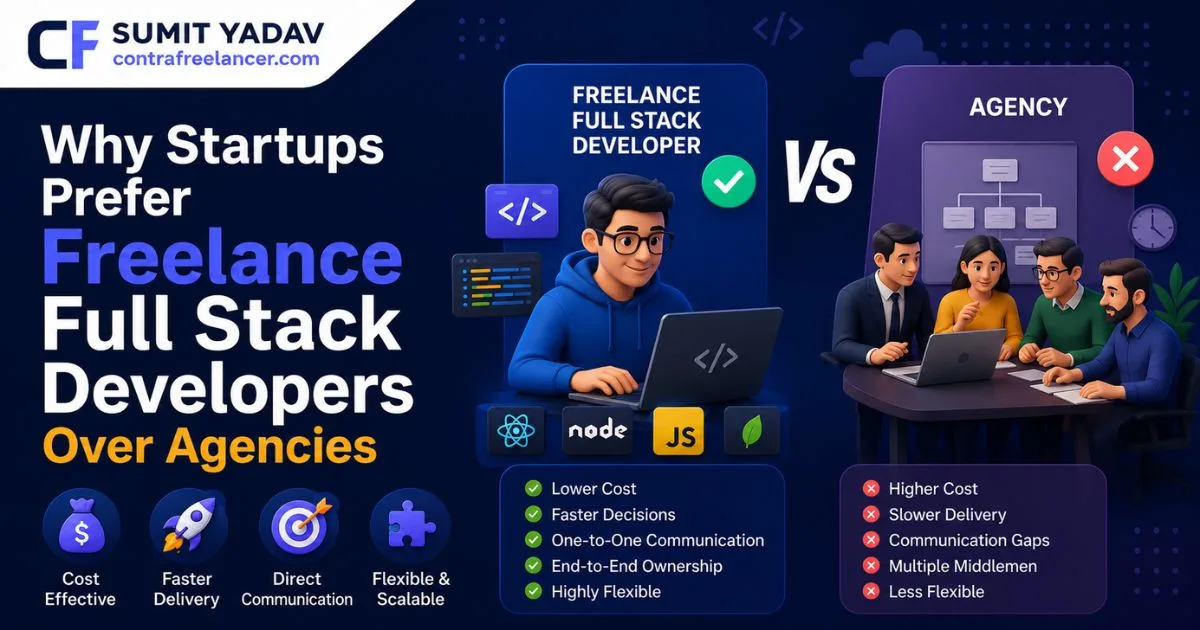
The startup world moves at a speed that traditional agencies simply cannot match. When you are racing to ship your MVP, validate a product idea, or onboard your first 1,000 users, every hour and every dollar counts. That is precisely why a growing number of founders in 2025–2026 are choosing to hire freelance full stack developer talent rather than signing contracts with large digital agencies.
According to Upwork's 2025 Freelance Forward report, over 64 million Americans freelanced in the past year, and the global freelance platform market is projected to surpass $14.5 billion by 2027. Within this surge, full stack developers professionals who handle both front-end and back-end development represent one of the most in-demand and high-value segments.
This article unpacks the real, data-backed reasons why startups are making this shift, what the trade-offs look like, and how to make the best hiring decision for your stage of growth. If you are a founder looking to build fast and smart, read on.
What Is a Freelance Full Stack Developer?
A freelance full stack web developer is a self-employed professional capable of working across the entire web development stack from database architecture and server-side logic to UI/UX design and client-side rendering. Unlike an agency that fields a team of specialists, a freelance full stack developer for startups acts as a one man army who can own a feature end-to-end.
Common skill sets include:
Front-end: React, Vue.js, Angular, HTML/CSS, Tailwind
Back-end: Node.js, Python (Django/FastAPI), Ruby on Rails, PHP (Laravel)
Databases: PostgreSQL, MongoDB, MySQL, Firebase
DevOps/Cloud: AWS, GCP, Docker, CI/CD pipelines
APIs: REST, GraphQL, third-party integrations
This versatility is precisely what makes them invaluable to lean startup teams.
Comparison Between The Agency Model vs. the Freelance Model
Factor | Digital Agency | Freelance Full Stack Developer |
Cost (Monthly Avg.) | $15,000 – $50,000+ | $3,000 – $12,000 |
Onboarding Time | 2–6 weeks | 1–3 days |
Communication | Account manager layer | Direct, real-time |
Flexibility | Contract-bound, rigid | Highly adaptable |
Accountability | Shared across team | Single point of ownership |
Specialization | Team-based, siloed | Full-stack, end-to-end |
Availability | Business hours, scheduled | Often async-friendly |
Equity/Partnership | Rarely open to it | Often negotiable |
The numbers speak for themselves. For a pre-Series A startup, the cost difference alone can mean the difference between running out of runway in month 8 versus month 14.
7 Reasons Startups Choose a Freelance Full Stack Developer Over an Agency
1. Dramatically Lower Costs Without Sacrificing Quality
Agencies bundle overhead into every invoice office rent, project managers, sales staff, account coordinators, and profit margins that can hit 40–60%. When you hire a freelance full stack developer directly through website like Contra Freelancer, you pay for skill and output, not institutional overhead.
A mid-level full stack freelancer on website like Contra Freelancer typically charges $50–$120/hour. Agencies billing the same calibre of developer often charge $150–$300/hour with a 3-month minimum commitment. For a startup burning $20K/month, switching to a freelancer can immediately extend runway by months.
2. Speed to Deployment
Agencies have processes: discovery sessions, legal reviews, design sprints, internal approvals. Freelancers ship. When your landing page needs to go live in 48 hours to capitalise on a press mention, a freelance full stack web developer can make that happen. Many experienced freelancers have boilerplate setups, reusable component libraries, and deployment pipelines that let them deliver production-ready code faster than most agency teams.
3. Direct Communication and Radical Transparency
One of the biggest frustrations startup founders report with agencies is the communication bottleneck. You talk to an account manager who talks to a project lead who talks to the developer. By the time feedback loops, the original requirement has been diluted or lost.
A freelance full stack developer for startups gives you direct Slack, Notion, or GitHub access. You see commits in real time, raise a bug and have it fixed within the hour, and iterate with the speed your business demands. Want to Let's Talk about a sprint? You're talking directly to the person writing the code.
4. Greater Flexibility and Scalability
Startup needs are inherently unpredictable. You might need 60 hours of work this month and only 20 hours next month. Agency retainers penalize you for that variability. Freelancers, by contrast, can operate on project-based, hourly, or part-time retainer arrangements that scale up or down as your needs evolve.
This flexibility extends to the technology stack, too. If you pivot your product from a mobile-first experience to a SaaS dashboard, a skilled freelancer can adapt their toolset. Agencies are often locked into their preferred stack based on internal expertise.
5. Single Point of Accountability
When you work with an agency and something goes wrong, it is rarely clear whose fault it is. Was it a miscommunication with the project manager? A junior developer who misread the brief? A designer who handed off incomplete assets?
With a freelance full stack developer, accountability is crystal clear. One person owns the codebase, the architecture decisions, and the delivery timeline. This is not just convenient — it is a fundamentally healthier working relationship built on trust and transparency.
6. Access to Niche Expertise on Demand
Modern startups often need highly specific skills: Stripe integrations, WebSocket real-time features, OpenAI API implementations, or blockchain-based authentication. Agencies generalize; freelancers specialize. Website like Contra Freelancer allow you to search for developers by skill tag, making it possible to find someone who has shipped exactly the kind of feature you need often within hours. If you want to Hire Me for a specific integration or prototype, you can evaluate portfolios, read client reviews, and make a data-driven hiring decision instantly.
7. Mission Alignment and Startup Culture Fit
Many freelance full stack developers have worked with or founded startups themselves. They understand the pressure of a tight runway, the excitement of a product-market fit discovery, and the need to "build it right the first time" under resource constraints. Agencies, by contrast, often treat startup clients as small accounts assigning junior staff to projects while senior talent works on enterprise contracts.
The best freelancers become genuine collaborators. They push back on bad decisions, suggest better architectures, and take pride in the product they are building. You can View My Projects to see the kind of collaborative, founder-friendly work ethic that distinguishes top freelancers from agency teams.
Cost Comparison: Agencies vs. Freelancers for Common Startup Tasks
Task | Agency Cost (Est.) | Freelance Cost (Est.) | Time Difference |
MVP Development (3 months) | $45,000 – $90,000 | $12,000 – $30,000 | Freelance 30–50% faster |
Landing Page + CMS | $5,000 – $15,000 | $800 – $2,500 | Freelance 2–5x faster |
API Integration (e.g., Stripe, Twilio) | $3,000 – $8,000 | $500 – $2,000 | Similar timeline |
Bug Fixes & Ongoing Maintenance | $2,000+/month retainer | $500 – $1,500/month | Freelance more flexible |
Full SaaS Dashboard (6 months) | $80,000 – $200,000 | $25,000 – $60,000 | Comparable quality |
These figures are based on 2024–2025 market data aggregated from Clutch, Toptal, Contra Freelancer, and Upwork pricing benchmarks.
When Should a Startup Choose an Agency Instead?
You are post-Series B with a large product team and need a creative agency for brand/marketing campaigns.
You require a very large team fast — say, 10+ developers onboarded in 30 days for a major product launch.
Your project involves deep regulatory compliance (e.g., HIPAA, GDPR, SOC 2) where agency legal teams provide contractual protections.
You have no technical co-founder or CTO and need the agency to act as a fractional technical leadership layer.
Even in these scenarios, many founders choose to hire a freelance full stack developer for startups to lead the technical strategy, and then coordinate agency resources as needed.
How to Find and Vet a Freelance Full Stack Developer for Your Startup
Finding the right freelancer is part science, part art. Here is a practical framework:
Step 1 — Define Your Stack and Deliverables
Before posting a job, define what you are building, the technology stack, and the key deliverables (e.g., "React + Node.js MVP with Stripe billing and user auth, deployed on AWS").
Step 2 — Use the Right Platforms
Contra Freelancer — Commission-free, portfolio-forward, ideal for startup-ready developers
Toptal — Rigorous screening, premium pricing
Upwork — Large talent pool, variable quality
Gun.io — Developer-focused, strong vetting
Step 3 — Evaluate Technical and Communication Skills
Ask for a short paid test task (2–4 hours). Review their GitHub profile, past project write-ups, and client testimonials. A great freelancer will have clear, thoughtful answers to questions about past architectural decisions.
Step 4 — Start with a Bounded Sprint
Begin with a 2-week paid sprint rather than a 6-month contract. Use this to evaluate code quality, communication cadence, and cultural fit before committing further.
Red Flags to Watch Out For When You Hire Freelance Full Stack Developer Talent
Red Flag | What It Signals |
Vague portfolio with no live links | May be overstating experience |
Unwilling to do a paid test task | Lack of confidence in work quality |
No questions about your product or users | Not genuinely engaged |
Promises unrealistic timelines | Over-commitment, under-delivery likely |
Poor communication during pre-hire chat | Will worsen under deadline pressure |
No version control or documentation habits | Technical debt risk |
Lowest bidder by a wide margin | Often reflects corner-cutting |
What the Data Says: Freelance Full Stack Developers in 2025
The global gig economy is worth over $455 billion as of 2023 (Statista), with tech freelancing among the fastest-growing segments.
59% of hiring managers at startups say they plan to increase their use of freelance tech talent in the next 12 months (Upwork, 2024).
Startups that engage freelance developers ship MVPs 40% faster on average compared to those using agencies, according to a 2023 Clutch survey of 500 early-stage companies.
Full stack developers are consistently ranked among the top 5 most in-demand freelance roles globally (LinkedIn Workforce Report, 2024).
Website like Contra Freelancer are growing at over 200% year-over-year in developer signups, reflecting a massive shift in how talent wants to work.
Conclusion
The evidence is clear: for most early-stage and growth-stage startups, a freelance full stack developer for startups offers a compelling combination of cost efficiency, speed, flexibility, and direct accountability that traditional agencies simply cannot match. From slashing development costs by 50–70% to shipping code faster and communicating with radical transparency, the freelance model is purpose-built for the way modern startups operate.
Whether you are building your first MVP, launching a new feature, or scaling your product to the next level, the right freelance full stack web developer can become one of the most valuable contributors to your company's success. Website like Contra Freelancer have made it easier than ever to find, vet, and work with world-class developers without the overhead, bureaucracy, or inflexibility of the agency model.
The best startups in the world are not the ones with the biggest budgets. They are the ones that move fast, stay lean, and build smart. A great freelance full stack developer helps you do all three.
FAQ
Q1: What is a freelance full stack developer for startups?
A freelance full stack developer handles both front-end and back-end development, helping startups build and scale web applications.
Q2: How much does itst to hire a freelance full stack developer?
Rates usually range from $40–$150 per hour, depending on experience and expertise.
Q3: Is it safe to hire a freelance full stack developer long-term?
Yes, with proper contracts, communication, and project documentation.
Q4: What is Contra Freelancer?
Contra Freelancer is a commission-free platform that connects businesses with independent freelancers.
Q5: Can one freelancer handle design and development?
Yes, many can, but complex design projects may benefit from a dedicated UI/UX designer.
Q6: Which platforms are best for hiring freelance developers?
Contra Freelancer, Upwork, Toptal, and Gun.io are popular options for finding skilled talent.+