

Difference Between A Custom Website And A Template?
4 min
Web Development
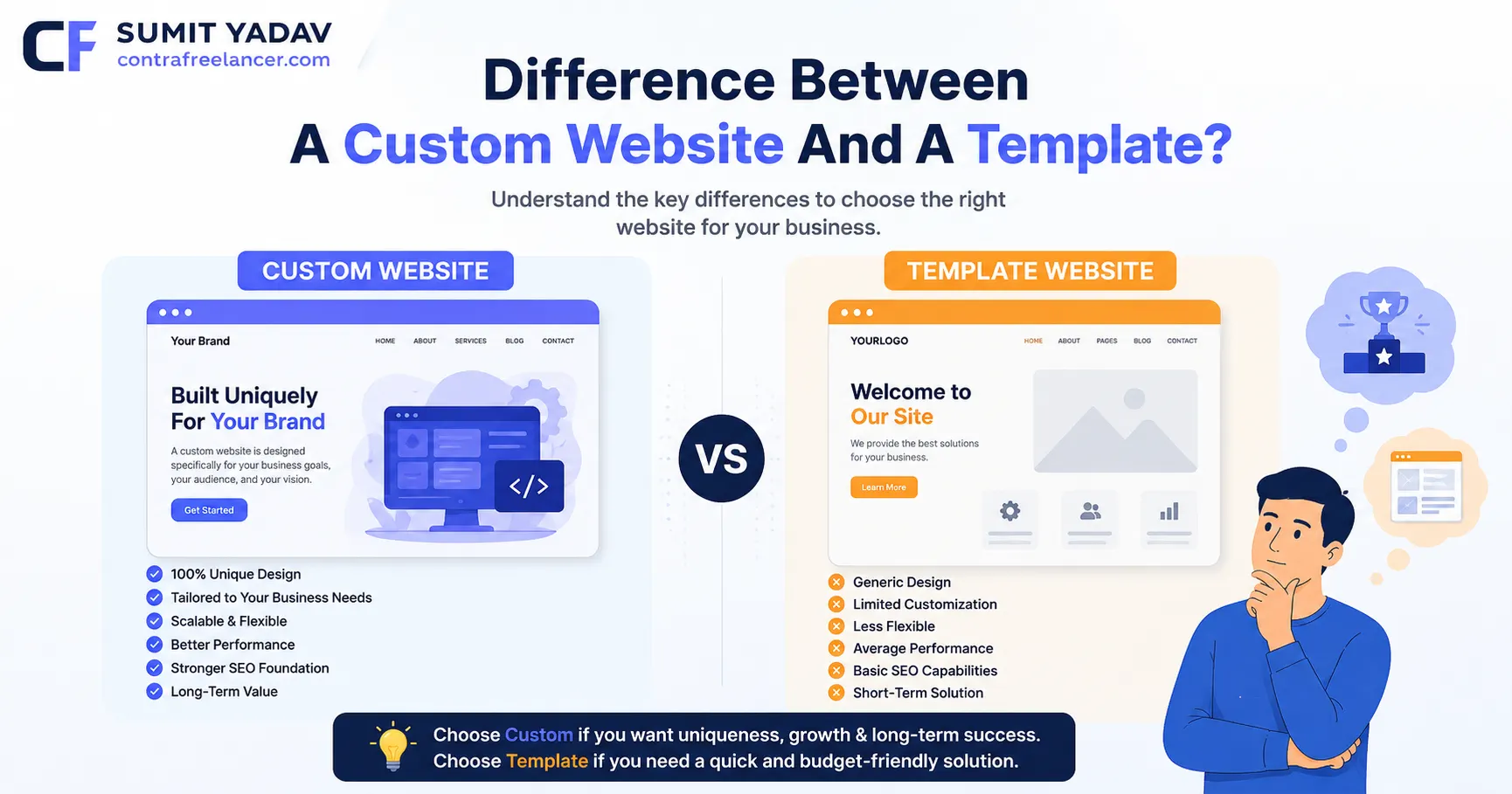
Difference Between A Custom Website And A Template?
Building a website is one of the most important investments a business can make. But before writing a single line of code or choosing a color palette, you face a foundational question should you go with a custom website or a ready-made template?
The answer to this question affects your brand identity, your search engine rankings, your security, and your long-term growth potential. The Difference Between A Custom Website And A Template is not just about looks it runs deep into performance, SEO, scalability, and user experience.
In this guide, we break down everything you need to know with real data, expert insights, and honest comparisons so you can make the right decision for your business.
Difference Between A Custom Website And A Template — A Complete Overview
At its core, the difference is simple:
A template website is a pre-designed layout built for general use. Thousands of businesses use the same template, just with different logos and content.
A custom website is designed and developed from scratch built specifically for your brand, your audience, and your goals.
But this surface-level difference leads to massive downstream impacts in how your site performs, ranks, and converts.
What Is a Template Website?
A template website uses a pre-built design available on platforms like WordPress, Wix, Squarespace, or Shopify. You pick a theme, add your content, and you're live often within hours.
Key traits of a template website:
Shared design used by thousands of other websites
Quick to launch with minimal technical knowledge
Often bloated with unused code and plugins
Limited customization without hiring a developer
Low upfront cost, but hidden long-term limitations
What Is a Custom Website?
A custom website is built from zero every pixel, every function, every line of code is written specifically for you. It reflects your unique brand identity and is engineered to meet your exact business objectives.
If you want to understand what premium custom builds look like in practice, you can View My Projects to see real-world examples of performance-first custom development.
Key traits of a custom website:
100% original design aligned with your brand
Clean, optimized codebase with zero bloat
Full control over SEO, performance, and features
Scalable architecture built to grow with your business
Higher upfront investment with far superior long-term ROI
Difference Between A Custom Website And A Template — Head-to-Head Comparison
Feature | Custom Website | Template Website |
|---|---|---|
Design Uniqueness | Fully original, brand-specific | Shared with thousands of sites |
Page Speed | Lean code, fast load times | Bloated, slower performance |
SEO Control | Full technical SEO flexibility | Platform-restricted |
Scalability | Unlimited expansion | Capped by platform limits |
Security | Custom-configured, robust | Relies on plugin/platform updates |
Brand Identity | Perfectly aligned | Generic and interchangeable |
Cost (Upfront) | $3,000–$50,000+ | $0–$500 |
Long-Term ROI | High | Moderate to Low |
Reasons Why Custom Websites Rank Better Than Templates
This is the section that matters most for any business relying on Google traffic. The Reasons Why Custom Websites Rank Better Than Templates are firmly grounded in how Google's algorithm evaluates websites and templates consistently fall short on every major signal.
Page Speed and Core Web Vitals
Google's ranking algorithm places heavy weight on Core Web Vitals specifically:
LCP (Largest Contentful Paint): How fast your main content loads
FID (First Input Delay): How quickly your page responds to user input
CLS (Cumulative Layout Shift): How stable your layout is during loading
Template websites fail these benchmarks regularly because of globally-loaded CSS frameworks, render-blocking JavaScript, and unoptimized third-party plugins. Custom websites are coded to load only what each page needs resulting in dramatically faster performance.
Full Technical SEO Control
Custom websites give developers complete control over:
Schema markup and structured data
Canonical tags and URL architecture
Hreflang for multilingual targeting
Custom XML sitemaps and robots.txt
Server-side rendering (SSR) vs. client-side rendering
Dynamic internal linking structures
Template platforms either restrict these features entirely or implement them poorly leaving significant SEO value on the table.
Clean, Crawlable Code Structure
Search engine bots read your code. Template platforms generate bloated, duplicated, or JavaScript-heavy markup that confuses crawlers and wastes your crawl budget. A custom site ensures every heading (H1 → H6), internal link, image alt tag, and meta element is structured exactly as SEO demands.
Mobile-First Architecture
Google uses mobile-first indexing, meaning it ranks your mobile site not your desktop site. Custom websites can be architected mobile-first from day one. Templates are often desktop designs retrofitted with responsive breakpoints a structural weakness that hurts mobile rankings.
No Shared Infrastructure Risks
Template platforms host thousands of websites on shared servers. If neighboring sites get flagged for spam or trigger slow server responses, your site can suffer indirectly. Custom-hosted websites run on isolated, optimized environments that you fully control.
Custom Websites Rank Better Than Templates — Performance Data
The proof is in the numbers. Custom Websites Rank Better Than Templates across every Core Web Vitals metric that Google uses as a ranking factor:
Metric | Custom Website (Avg.) | Template Website (Avg.) |
|---|---|---|
Google PageSpeed Score (Mobile) | 85–95 | 45–70 |
LCP (Largest Contentful Paint) | Under 2.5 seconds | 3–6 seconds |
Total Blocking Time | Under 200ms | 400–1,200ms |
Cumulative Layout Shift | Under 0.1 | 0.15–0.4 |
Avg. Organic Traffic Growth (Year 1) | +60–120% | +20–40% |
These are not marginal differences they represent the gap between page 1 and page 3 of Google search results.
Branding and Design: Why Templates Make You Look Generic
Your website is your brand's digital handshake. Template websites look like templates and your visitors know it. When your competitor is using the same Squarespace theme, differentiation becomes nearly impossible.
Custom websites enable:
Pixel-perfect branding consistent with your offline identity
Custom micro-interactions and animations that reflect your personality
Bespoke user journeys engineered for your specific conversion goals
Accessibility-first design tailored to your exact audience demographic
Businesses that invest in custom design consistently report lower bounce rates, higher session durations, and stronger brand recall all of which are behavioral signals Google monitors.
Cost Comparison: Short-Term Savings vs. Long-Term Value
Many businesses assume templates are the budget-friendly choice. The reality is more complex:
Cost Factor | Custom Website | Template Website |
|---|---|---|
Initial Build Cost | $3,000–$50,000+ | $0–$500 |
Monthly Platform Fees | $20–$200 | $25–$500 |
Plugin/Add-on Costs | Minimal | $50–$300/month |
Developer Customization | Built-in | $100–$250/hr as needed |
SEO Performance ROI (3 Years) | High | Moderate to Low |
Migration Costs (If Outgrown) | Planned and controlled | Expensive platform migrations |
When measured across a 3–5 year horizon, custom websites deliver significantly stronger ROI particularly for businesses where organic traffic and brand positioning are primary growth drivers.
Who Should Choose a Template Website?
Templates aren't wrong for everyone. They make sense when:
You're validating a business idea and need speed over perfection
You operate a personal blog or low-traffic portfolio
You're on an extremely tight budget with minimal growth ambitions
You need a short-term landing page or campaign microsite
For everyone else especially growth-focused businesses the custom route is the smarter long-term play.
The Developer Question: Freelancer vs. Agency
Not all custom websites are equal much depends on who builds yours. Many founders today explore Why Startups Choose Freelance Full Stack Developers over traditional agencies, drawn by faster communication, personalized service, and competitive rates.
Understanding the real-world dynamics of a Freelance Full Stack Developer vs Agency relationship helps you choose the right partner for your custom build balancing quality, timeline, and budget.
Contra Freelancer is one of the leading platforms connecting businesses with vetted, top-tier independent developers who build custom websites optimized for both visual impact and search performance. Working with Contra Freelancer means you're matched with professionals who understand that every technical decision has a business consequence.
Scalability: Building for Where You're Going, Not Just Where You Are
Template platforms hit growth ceilings fast limited database structures, paywalled features, and inability to integrate custom APIs. Custom websites can be engineered with scalability as a core architectural principle:
Headless CMS (Contentful, Sanity) for enterprise-scale content
API-first design for seamless CRM, ERP, and marketing integrations
Custom caching and CDN configurations for global audiences
Microservices or modular architecture for complex functionality
Conclusion
The Difference Between A Custom Website And A Template is ultimately a question of ambition. Templates offer speed and low cost perfect for experimenting or operating at the smallest scale. But for businesses serious about their brand, their SEO rankings, and their long-term digital growth, a custom website is not a luxury it is a strategic necessity.
The Reasons Why Custom Websites Rank Better Than Templates are backed by data, rooted in Google's algorithm, and proven across industries. The evidence is clear: Custom Websites Rank Better Than Templates when it comes to Core Web Vitals, crawlability signals. Website like Contra Freelancer make it easier than ever to access world-class custom development talent without the overhead of a large agency. The real question isn't whether you can afford a custom website it's whether you can afford to compete without one.
FAQs
Q: What is the main difference between a custom website and a template?
A: A custom website is built from scratch for your specific needs, while a template is a pre-designed layout used by many different businesses.
Q: Do custom websites always rank higher than template websites?
A: Not always, but custom websites have significant technical SEO advantages faster load times, cleaner code, and greater flexibility that make higher rankings more achievable.
Q: Are template websites ever a good choice?
A: Yes for early-stage startups, personal projects, or tight-budget scenarios where speed to launch matters more than performance optimization.
Q: How much does a custom website cost compared to a template?
A: Custom websites typically cost $3,000–$50,000+ to build, while templates can be set up for under $500 — but long-term platform and plugin fees can make templates more expensive over time.
Q: Can I migrate from a template to a custom website later?
A: Yes, but it can be costly and complex; it's better to plan for a custom build early if growth is a priority.
Q: How long does it take to build a custom website?
A: Depending on complexity, custom websites typically take 4–16 weeks to design, develop, test, and launch.