

Landing Page vs. Website: What Does Your Small Business Need?
6 min
Web Development
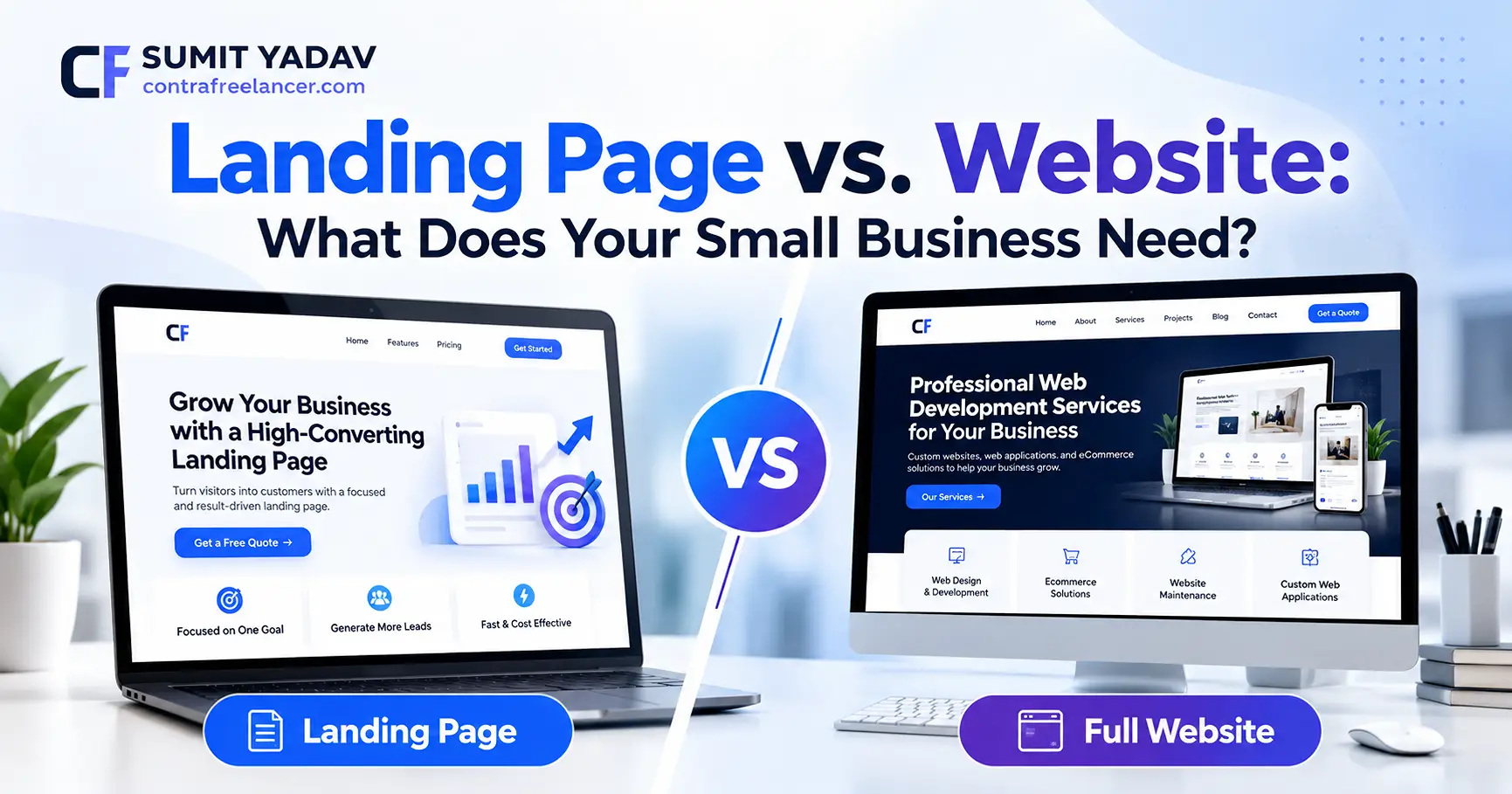
Choosing between a landing page and a complete website is an important decision for any small business. Both options can help attract customers, promote services, and generate leads, but they serve different purposes. The right choice depends on your business goals, marketing strategy, budget, and the experience you want to provide visitors.
In this guide, we will explain the differences between a landing page and a website, their benefits, costs, and how to decide which option is best for your small business.
What Is a Landing Page?
A landing page is a standalone web page designed to encourage visitors to complete one specific action. This action could include submitting a contact form, booking a consultation, downloading a resource, or purchasing a product.
Businesses commonly use landing pages for Google Ads campaigns, product launches, special offers, and lead generation. Unlike a complete website, a landing page usually has limited navigation and focuses on a single conversion goal.
For example, a web development company might create a landing page specifically for small business website design services. The page could include a compelling headline, service benefits, testimonials, pricing information, and a contact form.
Benefits of a Landing Page
Focused messaging: Visitors can quickly understand your offer and its value.
Better campaign alignment: Match the page content to the advertisement or marketing campaign.
Lead generation: Encourage visitors to submit inquiries or request quotes.
Faster development: A focused page generally requires less time and fewer resources to build.
Conversion testing: Test different headlines, calls to action, and layouts to improve results.
A landing page is particularly useful when your business wants to promote one service, test a new offer, or generate leads from a targeted marketing campaign.
What Is a Business Website?
A business website is a collection of interconnected pages that provide comprehensive information about a company, its services, products, and expertise.
A typical small business website may include a homepage, About page, service pages, portfolio, blog, contact page, and customer testimonials. Each page serves a different purpose while helping visitors understand the business.
For example, a professional web development business may need separate pages for WordPress development, e-commerce solutions, website maintenance, and custom application development.
If you are exploring different development approaches, read our guide on custom website vs. WordPress website to understand which solution may suit your business requirements.
Benefits of a Business Website
Complete business information: Explain your services, company background, expertise, and contact options.
Long-term SEO opportunities: Create useful content and service pages targeting different search queries.
Brand credibility: Demonstrate experience through case studies, testimonials, and portfolio projects.
Multiple conversion paths: Allow visitors to contact you, request a quote, book appointments, or explore products.
Business growth: Add new services, landing pages, resources, and functionality as your business expands.
A complete website is generally a better foundation for businesses that want to build an online presence and attract customers through multiple channels.
Landing Page vs. Website: Key Differences
Understanding the main differences will help you choose the right option.
Feature | Landing Page | Business Website |
|---|---|---|
Primary purpose | One specific conversion goal | Multiple business objectives |
Structure | Usually one focused page | Multiple connected pages |
Navigation | Limited or simplified | Full navigation menu |
SEO opportunities | Focused on a specific topic or offer | Broader range of keywords and topics |
Development cost | Usually lower | Usually higher |
Development time | Generally shorter | Depends on pages and functionality |
Best suited for | Ads, campaigns, lead generation | Long-term business growth |
Content | Focused on one offer | Services, company details, blog, and more |
Scalability | Can expand with additional pages | Designed to support broader growth |
Actual costs and development time depend on design complexity, integrations, content requirements, and functionality.
How Much Does Each Option Cost?
The cost of building a landing page or a business website varies depending on the developer, project scope, design requirements, and technology used.
A landing page generally costs less because it has a narrower scope. However, custom animations, advanced forms, CRM integrations, and conversion tracking can increase the cost.
A business website may require more investment because it often includes multiple page templates, responsive layouts, SEO configuration, content management, and additional features.
If you are planning your budget, read our detailed guide on how much a website costs for a small business in 2026. It explains the factors that influence website development costs and helps businesses plan their projects more effectively.
Instead of choosing an option based only on the initial price, consider the long-term value it can deliver through lead generation, customer acquisition, and business growth.
Which Option Is Better for SEO?
A complete business website generally offers more opportunities for long-term search engine optimization because you can create individual service pages, publish blog articles, build internal links, and target different search intents.
For example, a small business can create separate pages for website design, e-commerce development, website maintenance, and other services. These pages can address the specific questions and needs of potential customers.
A landing page can also appear in search results when its content matches a relevant query and meets search quality requirements. However, a single page naturally has fewer opportunities to target a wide range of topics than a well-structured website.
To strengthen your online presence, explore our guide on how to make your business website stand out from competitors. It covers ways to differentiate your website and create a stronger experience for potential customers.
Remember that neither option guarantees rankings. Search visibility depends on content quality, relevance, technical performance, competition, and other SEO factors.
When Should You Choose a Landing Page?
A landing page may be the right choice if:
You are running a targeted Google Ads or social media campaign.
You want to promote one specific service or offer.
Your primary goal is to generate leads or consultation requests.
You are testing a new business idea before investing in a complete website.
You already have a website but need a dedicated page for a marketing campaign.
For example, a consultant promoting a limited-time business assessment could use a landing page with a clear offer, benefits, testimonials, and a booking form.
When Should You Choose a Complete Website?
A complete business website is generally the better option if:
You want to establish a professional online presence.
Your business offers multiple services or products.
You want to attract organic traffic through SEO.
You need a blog, portfolio, case studies, or customer resources.
You plan to expand your services or functionality over time.
A business website is particularly valuable when customers need to research your company before making a purchasing decision.
If you need help choosing a development partner, read our article on how to choose the right freelance web developer for your business.
Can You Use Both a Landing Page and a Website?
Yes. In fact, combining both options can be an effective strategy for many small businesses.
Your main website can establish credibility, explain your services, and support long-term SEO. Dedicated landing pages can then target specific campaigns, offers, audiences, and conversion goals.
For example, a business might maintain a complete website with separate service pages while creating dedicated landing pages for paid advertising campaigns.
To make this strategy effective, ensure that each page has a clear purpose, useful content, a strong call to action, and a mobile-friendly design. Track conversions to understand which pages generate meaningful business results.
Conclusion
Choosing between a landing page and a complete website depends on what you want to achieve. A landing page is an excellent option for focused campaigns and specific conversion goals, while a complete website provides a stronger foundation for long-term SEO, brand credibility, and business expansion.
For many small businesses, the best approach is to start with the option that fits their immediate needs and expand as their goals evolve. If your business needs a broader online presence, a complete website may be the better investment. If you are promoting one offer or running a targeted campaign, a landing page may be sufficient.
Contra Freelancer can help businesses explore web development solutions that align with their goals, budget, and growth plans.
Frequently Asked Questions (FAQs)
1. Is a landing page better than a website?
Neither is universally better. A landing page is useful for focused campaigns and lead generation, while a complete website is better suited to businesses that need multiple pages, broader SEO opportunities, and comprehensive company information.
2. Can a landing page rank on Google?
Yes. A landing page can rank in Google if its content is relevant, useful, accessible to search engines, and competitive for the targeted query. Rankings are not guaranteed.
3. How many pages should a small business website have?
There is no fixed number. A small business can start with a homepage, About page, service pages, and contact page, then add a blog, portfolio, or other resources as needed.
4. Can I turn a landing page into a full website later?
Yes. You can expand a landing page into a larger website by adding service pages, company information, blog content, and additional functionality. Planning a scalable structure can make future expansion easier.
5. Should I build a website before running Google Ads?
Not necessarily. A dedicated landing page can work well for a targeted advertising campaign. However, your business should provide sufficient information, trustworthy contact details, and a professional user experience to build customer confidence.