
Custom Website vs WordPress Website: Which One Does Your Business Need?
5 min
Web Development
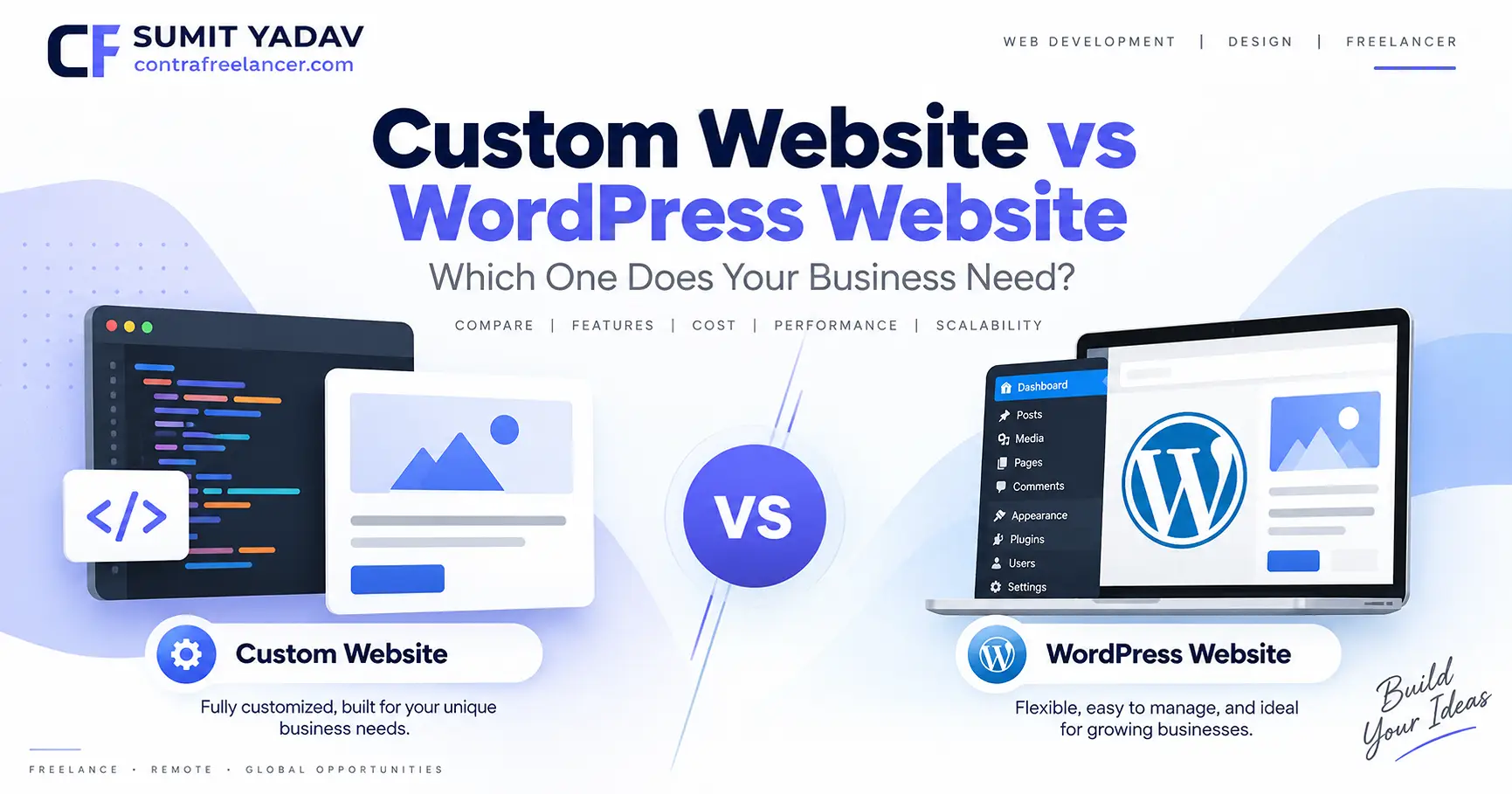
Choosing the right technology for a business website can be challenging, especially when deciding between a custom website and WordPress. Both options can create professional, responsive, and SEO-friendly websites, but they are designed for different business needs, budgets, and levels of customization.
If you are planning a new website or considering a redesign, understanding the difference between a custom website and WordPress can help you make a more informed decision.
What Is a Custom Website?
A custom website is built specifically for a business using technologies and frameworks selected according to the project's requirements. Instead of starting with a pre-built WordPress theme, developers create the website's structure, functionality, and user experience around the business.
Custom websites can be developed using technologies such as HTML, CSS, JavaScript, React, Node.js, PHP, or other frameworks and platforms.
The biggest advantage is flexibility. Businesses can create unique features, custom dashboards, integrations, workflows, and experiences that may be difficult to achieve with a standard CMS setup.
However, custom development generally requires more planning, development time, and technical expertise.
What Is a WordPress Website?
WordPress is a content management system (CMS) that allows businesses to create and manage websites without building every feature from scratch.
A WordPress website can use themes, plugins, page builders, custom development, and third-party integrations to provide a wide range of functionality.
WordPress is commonly used for business websites, blogs, portfolios, service websites, membership platforms, and ecommerce stores.
For businesses that want a manageable website with a familiar content management system, WordPress can provide a practical starting point.
Custom Website vs WordPress Website: Key Differences
1. Customization
Customization is one of the biggest differences between the two approaches.
A custom website can be designed around a company's exact requirements. Developers have greater control over the website's architecture, functionality, database structure, and user experience.
WordPress also supports extensive customization, particularly when custom themes and plugins are developed. However, websites relying heavily on third-party themes and plugins can have limitations depending on the tools being used.
If your business requires highly specialized functionality, custom development may provide greater control.
2. Cost
The cost of website development depends on the project's size, functionality, design requirements, integrations, and development time.
WordPress can often reduce initial development costs because businesses can start with an existing theme or plugin ecosystem.
Custom websites generally require more development work, which can increase the initial investment.
However, businesses should consider long-term maintenance, updates, security, hosting, and future development rather than comparing only the initial price.
For a broader breakdown of website expenses, read our guide on How Much Does a Website Cost for a Small Business in 2026?.
3. Development Time
A WordPress website can often be launched relatively quickly because many common website features are already available through themes and plugins.
A custom website usually takes longer because developers need to design and build the required components and functionality.
For example, a simple business website may be developed faster using WordPress, while a custom platform with user accounts, advanced workflows, APIs, and specialized functionality may require significantly more development time.
You can learn more about the factors that affect website timelines in How Long Does It Take to Build a Business Website?.
4. Content Management
WordPress was specifically designed as a content management system, making it convenient for businesses that regularly publish or update content.
Administrators can typically create pages, publish blog posts, upload media, and manage website content through the WordPress dashboard.
A custom website can also include a CMS or custom administration system, but the content management experience depends on how the development team builds it.
For businesses with frequent content updates, having an easy-to-use CMS can be an important consideration.
5. SEO
Both custom websites and WordPress websites can be optimized for search engines.
SEO performance depends on factors such as:
Website structure
Page speed
Mobile responsiveness
Technical SEO
Content quality
Internal linking
Metadata
Image optimization
Structured data
Server performance
WordPress provides many SEO tools and plugins that can simplify certain optimization tasks.
With a custom website, developers have more direct control over the underlying code and architecture, but SEO features need to be properly implemented during development.
Neither platform automatically guarantees better search rankings.
For businesses concerned about technical performance and search visibility, our guide on How to Improve Website Page Speed and Core Web Vitals in 2026 provides additional information.
6. Website Performance
Website performance depends more on implementation than simply whether a website uses WordPress or custom development.
A WordPress website with excessive plugins, poorly optimized images, inefficient code, or low-quality hosting can experience performance problems.
A custom website can be optimized specifically for the project's requirements, but poorly written custom code can also create performance issues.
For either approach, developers should consider Core Web Vitals, image optimization, caching, efficient code, responsive design, and hosting infrastructure.
7. Security
Security is another important consideration.
WordPress is widely used, which makes keeping the CMS, themes, and plugins updated particularly important. Businesses also need appropriate security practices, backups, secure hosting, and access controls.
Custom websites do not automatically eliminate security risks. They still require secure coding practices, server configuration, dependency updates, authentication controls, and ongoing maintenance.
The security of either option depends heavily on how the website is developed and maintained.
When Should Your Business Choose WordPress?
WordPress may be suitable if your business needs:
A professional company website
A service-based website
A business blog
Regular content publishing
A manageable CMS
A relatively fast website launch
Common integrations
Flexible design options
A website that internal staff can update
For many small businesses, startups, consultants, agencies, and service providers, WordPress can provide the functionality needed without requiring a fully custom platform.
If you are considering ongoing WordPress expenses, you can also review WordPress Website Maintenance Cost in the USA: Complete 2026 Guide.
When Should Your Business Choose a Custom Website?
Custom development may be more appropriate when your business requires:
Unique business workflows
Advanced web applications
Custom dashboards
Complex user roles and permissions
Specialized database structures
Advanced API integrations
Custom customer portals
Complex ecommerce functionality
Highly specialized interactive features
Greater control over the application architecture
In these situations, building around the specific requirements can make more sense than trying to adapt an existing theme and plugin combination.
What About a Hybrid Approach?
The decision does not always have to be completely custom or completely WordPress.
A business can use WordPress as the CMS while implementing custom development where necessary. Developers can create custom themes, custom plugins, API integrations, or specialized functionality while retaining WordPress for content management.
This approach can provide a balance between flexibility and ease of content management.
For example, a company could use WordPress for its marketing pages and blog while connecting it to a separate application or custom system for specialized business functionality.
Custom Website vs WordPress: Which Is More Scalable?
Scalability depends on what the business means by growth.
A WordPress website can scale effectively for many business websites when it is properly developed, hosted, cached, secured, and maintained.
A custom website may provide more architectural flexibility when the project evolves into a complex web application with specialized requirements.
Instead of asking which platform is universally more scalable, businesses should consider the type of functionality they expect to add over the next several years.
Questions to Ask Before Choosing
Before selecting WordPress or custom development, consider:
What type of website does the business need?
How much customization is required?
Who will manage the website after launch?
How frequently will content be updated?
Does the project require custom integrations?
What is the available development budget?
How quickly does the website need to launch?
What features may be required in the future?
Does the business need a customer portal or custom application?
What level of ongoing maintenance will be required?
Answering these questions can make the platform decision much easier.
Final Thoughts
There is no single website platform that is appropriate for every business.
A WordPress website can be a practical choice for businesses that need a flexible CMS, efficient content management, and common website functionality. Custom development can be appropriate for businesses that require specialized features, unique workflows, or greater control over the application's architecture.
The right choice should be based on your business goals, functionality, budget, timeline, content management needs, and future plans.
If you are unsure which approach fits your project, working with an experienced freelance web developer can help you evaluate the technical requirements before development begins. A proper assessment can prevent unnecessary development costs and ensure that your website is built around the actual needs of your business.