
Affordable Full Stack Web Development Services USA | Contra Freelancer
6 min
Web Development
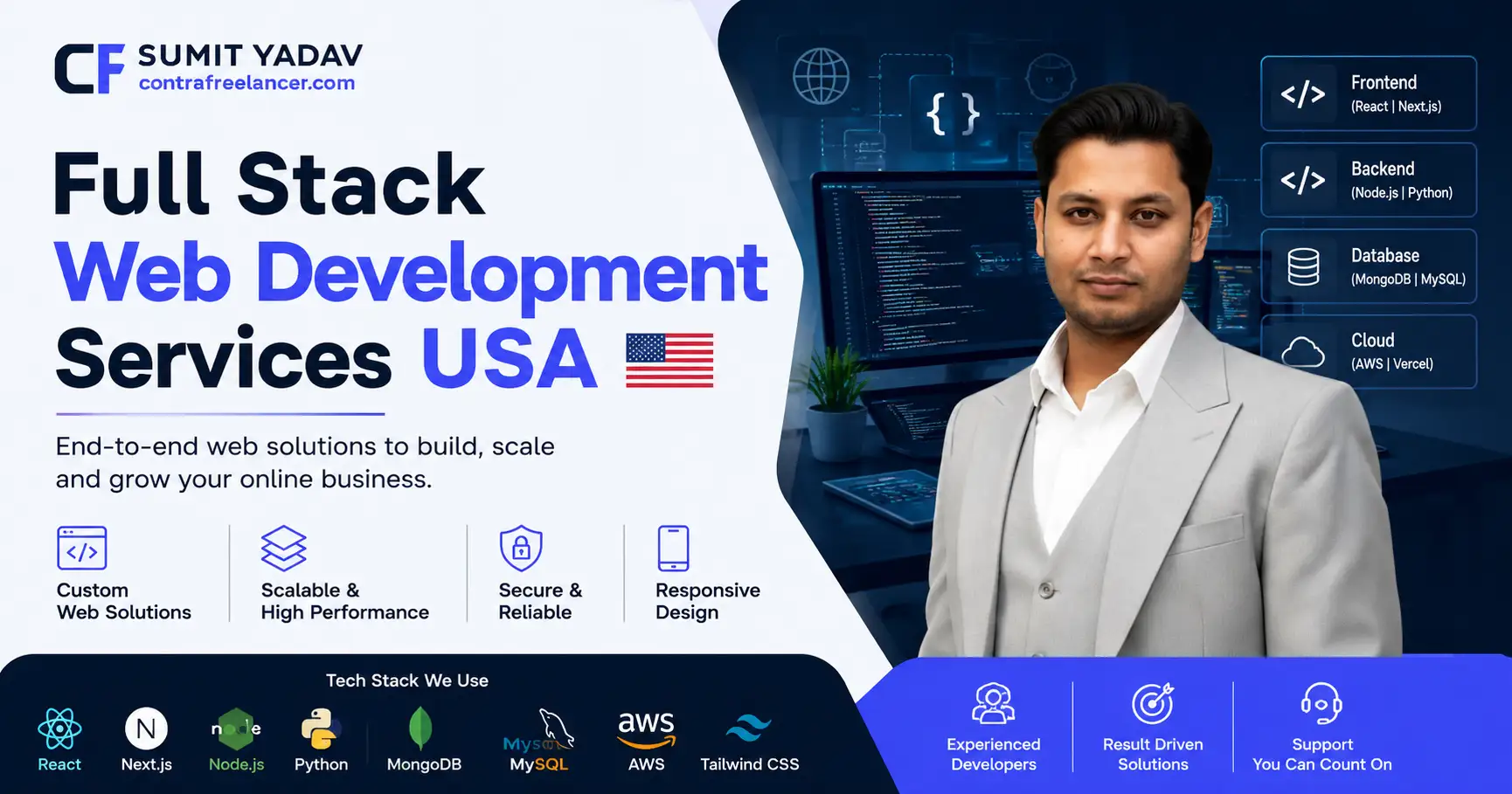
Every founder eventually hits the same wall: the idea is ready, the budget is tight, and the talent pool feels impossible to navigate. That is exactly where Full Stack Web Development Services USA earn their value, because a single skilled professional can carry a project from database schema to polished front-end without you assembling four separate specialists. Contra Freelancer has spent years watching this exact problem play out for startups, agencies, and small business owners, and this guide distills what actually works in 2026, what it costs, and how to avoid the expensive mistakes that sink web projects before launch.
Unlike the generic listicles that dominate this topic, this article is built around real 2026 pricing data, transparent comparisons, and practical decision frameworks rather than a recycled directory of agency names. If you are trying to decide between an in-house hire, an agency retainer, or a freelance specialist, the tables and breakdowns below will give you the numbers and reasoning to make that call with confidence.
What Affordable Full Stack Web Development Services USA Actually Include
A full stack engagement is not one service; it is a bundle of disciplines delivered by one accountable team or individual. When you commission Full Stack Web Development Services USA, you are typically paying for front-end interface work, server-side logic, database architecture, API integration, cloud deployment, and ongoing maintenance, all coordinated under a single point of contact instead of three or four disconnected vendors.
This matters more in 2026 than it did five years ago. Modern web products are expected to be fast, secure, mobile-first, and AI-ready from day one, and stitching together a front-end agency, a separate backend contractor, and an unrelated DevOps consultant introduces communication gaps that slow everything down. A genuinely full stack partner removes that friction. The table below breaks down the core service layers you should expect from any serious provider.
Core Service Layers Included in Full Stack Web Development Services in USA
Service Layer | What It Covers | Common Technologies Used |
|---|---|---|
Front-End Development | UI design implementation, responsiveness, accessibility, performance optimization | React, Vue.js, Next.js, Tailwind CSS |
Back-End Development | Business logic, server architecture, authentication, security | Node.js, Python (Django/Flask), Ruby on Rails, Java Spring Boot |
Database Architecture | Data modeling, storage, indexing, query optimization | PostgreSQL, MySQL, MongoDB |
API & Integrations | Connecting third-party tools, payment gateways, CRMs | REST, GraphQL, Stripe, Twilio |
Cloud & DevOps | Hosting, scaling, CI/CD pipelines, containerization | AWS, Docker, Kubernetes, Vercel |
Maintenance & Support | Bug fixes, updates, monitoring, security patches | Uptime monitoring tools, version control systems |
If you are evaluating a provider and any one of these layers is missing from their pitch, ask why. A team that only handles the visual layer and outsources everything else has quietly turned your "full stack" engagement back into the fragmented model this approach is supposed to solve.
Why Businesses Are Choosing Affordable Full Stack Web Development Services USA in 2026
Budget pressure has not disappeared just because the digital economy has matured. If anything, the opposite is true: more businesses now understand that a website is not a one-time expense but a living product requiring continuous investment, which makes cost-efficiency a long-term priority rather than a one-off negotiation. This is the central reason Hire Full Stack Web Development Services in USA has become such a common search query among founders and operations leads alike.
Three forces are driving this shift. First, remote and freelance hiring infrastructure has matured to the point where vetting, contracts, and payments can be handled professionally without a traditional agency markup. Second, AI-assisted development tools have measurably shortened build timelines, meaning skilled developers can now deliver more output per hour than they could two or three years ago, which directly affects pricing. Third, businesses that got burned by slow, expensive agency engagements during the last few years are actively seeking leaner alternatives, and that demand has pulled high-quality talent into freelance marketplaces like Contra Freelancer rather than only into traditional firms.
None of this means "affordable" should be confused with "cheap." The cheapest available developer is rarely the most cost-effective one once you account for rework, missed deadlines, and security gaps. Affordable, in the context that matters for your business, means paying a fair market rate for verified skill, without absorbing the overhead of a large agency's account managers, sales teams, and office leases.
How Much Do Full Stack Web Development Services USA Cost in 2026?
Pricing in this space varies enormously depending on who you hire and how you structure the engagement. Based on current 2026 market data from major compensation platforms, U.S.-based full stack developers earn an average salary in the range of $118,867 per year, which converts to roughly $57 per hour, though data drawn from job postings on Indeed places the average closer to $136,635 per year. Hourly freelance and contractor rates tell a different story because they reflect project-based risk and flexibility rather than salaried employment.
Full Stack Developer Hourly Rate Comparison by Engagement Type (USA, 2026)
Engagement Type | Typical Hourly Rate (USD) | Best Suited For |
|---|---|---|
In-house Full-Time Employee | $80 to $180 per hour (salary equivalent) | Long-term, mission-critical products needing tight internal alignment |
Independent Freelance Developer | $60 to $150 per hour | Defined projects, MVPs, and businesses needing flexible scaling |
Boutique Agency / Senior Specialist | $35 to $95 per hour | Complex builds needing project management plus technical depth |
Traditional Agency (Full Team) | $100 to $250 per hour | Enterprise projects requiring multiple specialists and account management |
Offshore Dedicated Team | $25 to $60 per hour | Budget-conscious projects with flexible timelines |
What this table makes clear is that the freelance independent model occupies a sweet spot: meaningfully cheaper than a full agency team, while typically offering more direct accountability and faster communication than an offshore black box. This is precisely why Best Full Stack Web Development Freelancer in USA searches have grown alongside agency-focused queries; buyers are doing the math and realizing that a vetted individual freelancer often delivers a better cost-to-quality ratio for small and mid-sized projects.
It's worth noting that a Custom Responsive Website Developer Freelancer USA engagement often costs less than people assume, precisely because freelancers operating through commission-free platforms don't have to inflate hourly rates to cover agency overhead, recruiter fees, or office expenses.
In-House Team vs Agency vs Freelancer: Which Model Actually Wins?
This is the question every business eventually has to answer, and the honest response is that no single model is universally correct. The right choice depends on project duration, internal technical literacy, budget flexibility, and how much hand-holding you need during execution.
An in-house team gives you maximum control and the deepest product knowledge over time, but it is the most expensive option once you factor in benefits, recruiting costs, equipment, and the months it can take to build a fully functioning team. A traditional agency solves the resourcing problem instantly and brings structured project management, but you pay a substantial premium for that convenience, and you are often working with whichever developer the agency assigns rather than someone you specifically vetted.
A skilled freelancer, particularly one sourced through a platform built specifically around commission-free, direct client relationships, threads the needle between these two extremes. You get to review actual portfolios and prior client feedback before committing, you negotiate rates directly without an agency markup sitting between you and the person doing the work, and you retain the flexibility to scale the engagement up or down as your needs change. This is the model Contra Freelancer was built to support, connecting businesses directly with vetted independent developers rather than routing every project through a layered agency structure.
In-House vs Agency vs Freelancer Comparison
Factor | In-House Team | Traditional Agency | Independent Freelancer |
|---|---|---|---|
Average Cost | Highest (salary + benefits + overhead) | High (team rate + management fees) | Moderate (direct hourly/project rate) |
Hiring Speed | Slow (weeks to months) | Fast (days) | Fast (days) |
Direct Communication | Yes | Often filtered through account managers | Yes, direct |
Flexibility to Scale | Low | Moderate | High |
Best For | Long-term core product teams | Large, multi-discipline enterprise projects | Startups, SMEs, defined-scope builds |
For businesses trying to understand why a freelance-first approach has gained so much traction recently, this breakdown of Why Startups Choose Freelance Full Stack Developers over agencies covers the operational reasoning in more depth, and it pairs naturally with the cost comparison above.
How to Hire Full Stack Web Development Services in USA the Right Way
Knowing the market is only half the job; knowing how to evaluate a specific candidate or team is what actually protects your budget. Businesses that get burned during the hiring process almost always skipped one of the same handful of steps, so treat the following as a non-negotiable checklist rather than optional advice.
Start by reviewing actual shipped work, not just a polished portfolio page. Ask for links to live products, not just static design mockups, and spend time clicking through them on both desktop and mobile. Next, verify the technology stack matches your project's actual needs; a developer who is brilliant at WordPress customization is not automatically the right fit for a React-based SaaS dashboard, and vice versa. Communication style matters just as much as technical skill, especially for remote engagements where misunderstandings compound quickly if updates are infrequent or vague.
When you're ready to Hire Full Stack Web Development Services in USA, request a short paid trial task before committing to the full project. This single step filters out a huge percentage of mismatched hires because it reveals real working habits, code quality, and responsiveness under modest time pressure, all without locking you into a multi-month contract. Pricing transparency is another filter: a freelancer or agency that hesitates to give you a clear hourly or fixed-price estimate after understanding your scope is a yellow flag worth taking seriously.
Choosing the Right Technology Stack for Your Project
A huge portion of the cost variance you'll encounter when comparing Best Full Stack Web Development Services in USA comes down to the technology decisions made before a single line of code is written. The right stack depends entirely on what you're building, how fast you need to move, and how the site will need to scale.
For content-driven sites like blogs, brochure sites, and small e-commerce stores, a CMS-based approach is often faster and cheaper to launch. For interactive, data-heavy applications, a JavaScript-based stack with a dedicated backend gives you far more flexibility long-term, even if the initial build takes slightly longer. This is also where the React.js vs WordPress For Business debate becomes relevant; React suits dynamic, app-like experiences with custom logic, while WordPress remains a strong, budget-friendly choice for content publishing and marketing sites that don't need heavy custom functionality.
Technology Stack Suitability by Project Type
Project Type | Recommended Stack Approach | Why It Fits |
|---|---|---|
Marketing Website / Blog | WordPress, Webflow | Fast to launch, content-editor friendly, lower upfront cost |
E-commerce Store | Shopify, WooCommerce, or custom MERN stack | Built-in payment and inventory tooling, scalable for growth |
SaaS Product / Web App | React/Next.js + Node.js + PostgreSQL | Handles complex logic, real-time data, and user accounts well |
Internal Business Tool | Python/Django or Ruby on Rails | Rapid development, strong admin tooling out of the box |
High-Traffic Enterprise Platform | Microservices architecture with cloud-native deployment | Scales independently, resilient under heavy load |
The table above is a starting point, not a rigid rulebook. A full stack developer worth hiring will push back on a mismatched request, for instance, talking a client out of a heavy custom build when a configured template would serve the business just as well for a fraction of the cost and timeline. That kind of honest pushback, more than any specific framework choice, is what separates a strategic technical partner from a vendor who simply executes whatever is requested without question.
E-E-A-T and Why It Matters When Choosing a Development Partner
Google's quality framework, E-E-A-T, stands for Experience, Expertise, Authoritativeness, and Trustworthiness, and while it was designed to evaluate published content, the same logic applies directly to evaluating a development partner. You want a provider who has firsthand experience shipping projects similar to yours, demonstrable expertise in the specific stack your project requires, a reputation that holds up under scrutiny from past clients, and transparent business practices you can verify before signing anything.
This matters for your own due diligence process. When you're comparing Full Stack Web Development Services USA, look for the same signals search engines reward in content: verifiable portfolios instead of vague claims, named individuals with traceable work history instead of anonymous "our team" language, and honest communication about limitations rather than overpromising. A freelancer or agency willing to say "this isn't something we specialize in" about a request outside their wheelhouse is demonstrating exactly the kind of trustworthiness that separates a long-term partner from a short-term liability.
Industries Benefiting Most from Full Stack Development in the USA
Certain industries lean on full stack expertise more heavily than others because their products demand tight integration between user experience and backend reliability. E-commerce businesses need full stack support to handle payment processing, inventory synchronization, and traffic spikes during sales events without downtime. Healthcare-adjacent platforms require careful attention to data security and compliance considerations, making backend expertise just as critical as front-end polish. SaaS startups depend on full stack developers almost by definition, since their entire product is a web application requiring continuous iteration across both layers simultaneously.
Professional services firms, real estate platforms, and education technology companies round out the list of frequent buyers, each needing custom functionality that off-the-shelf templates simply cannot deliver. Design-driven businesses in particular, agencies, photographers, boutique consultancies, often ask their freelancer to weigh in on the Difference Between Framer and Webflow before committing budget, since both platforms target visually polished sites but differ significantly in animation depth, CMS structure, and how easily a developer can hand off the finished build for ongoing edits. What unites all of these use cases is the need for one accountable technical partner who understands how a front-end decision ripples into backend performance, rather than two disconnected teams making isolated choices.
Red Flags to Avoid When Evaluating Providers
A few warning signs show up consistently across problematic engagements, and recognizing them early can save months of frustration. Be cautious of providers who quote a price before fully understanding your project scope, since this usually signals a rigid template approach rather than a tailored solution. Watch for vague answers about post-launch support; a provider who hasn't thought through maintenance is setting you up for a costly scramble the first time something breaks. Finally, be skeptical of anyone unwilling to provide references or links to live, functioning projects, because a portfolio with no verifiable backing is the clearest signal that experience claims may not hold up.
One more pattern worth watching for: vague scope documents. A trustworthy freelancer or small team will insist on a written scope before starting work, even for a modest project, because ambiguity early on is the single biggest predictor of budget overruns later. If a provider seems eager to start coding before agreeing on deliverables, timelines, and revision limits in writing, treat that eagerness as a caution sign rather than a sign of enthusiasm. Clear documentation protects both sides and tends to correlate strongly with how the rest of the engagement will unfold.
Conclusion
Choosing the right partner for Full Stack Web Development Services USA is less about finding the cheapest hourly rate and more about finding the most reliable cost-to-value ratio for your specific project. Part of that decision often comes down to platform choice long before a developer writes a single line of custom code; understanding the Pro & Cons of WordPress vs Webflow early in the planning process can save weeks of rework later, since migrating between fundamentally different platforms mid-project is far more expensive than choosing correctly at the outset. The data is clear that independent freelancers, when properly vetted, consistently deliver agency-quality output at a fraction of the overhead cost, which is exactly why platforms built around direct, commission-free client relationships have grown so quickly. Contra Freelancer exists to make that vetting process easier, giving businesses a transparent way to review real portfolios, negotiate fair rates, and build the kind of direct working relationship that produces better products and fewer surprises. Whether you're launching an MVP, rebuilding a legacy platform, or scaling an existing product, the principles in this guide, transparent pricing, verified experience, and the right technology stack for your specific use case, will serve you regardless of which engagement model you ultimately choose.
Frequently Asked Questions
What is the average cost of Full Stack Web Development Services USA in 2026?
Costs typically range from $25 to $250 per hour depending on whether you hire an offshore team, an independent freelancer, or a full-service agency, with independent freelancers generally offering the best balance of cost and direct accountability.
How do I Hire Full Stack Web Development Services in USA without overpaying
Compare at least three providers, request a small paid trial task before committing to a full project, and confirm the technology stack matches your specific business needs rather than choosing based on price alone.
What makes a provider count among the Best Full Stack Web Development Services in USA?
Verifiable portfolios, transparent pricing, clear post-launch support plans, and direct communication without layers of account management are the strongest indicators of genuine quality.
Is hiring a Best Full Stack Web Development Freelancer in USA cheaper than an agency?
Yes, freelancers typically charge $60 to $150 per hour compared to $100 to $250 per hour for full agency teams, since freelancers don't carry the same overhead costs.
How long does a typical full stack web project take to complete?
A simple business website usually takes two to four weeks, while a custom SaaS application or complex e-commerce platform can take three to six months depending on feature scope.
Do I need separate developers for front-end and back-end work?
No, a qualified full stack developer can handle both layers, which often reduces coordination overhead and speeds up delivery compared to hiring two separate specialists.
What technologies should I expect a modern full stack developer to know in 2026
Most competitive developers are fluent in React or Vue for the front end, Node.js or Python for the back end, and cloud platforms like AWS for deployment and scaling.
Can a freelancer handle an enterprise-level project on their own?
For most mid-sized enterprise needs, yes, especially with cloud-native architecture, though very large platforms with multiple concurrent workstreams may still benefit from a small freelance team rather than a single individual.