

Process to Hire Full Stack Web Developer For Hourly in USA
5 min
Freelancing
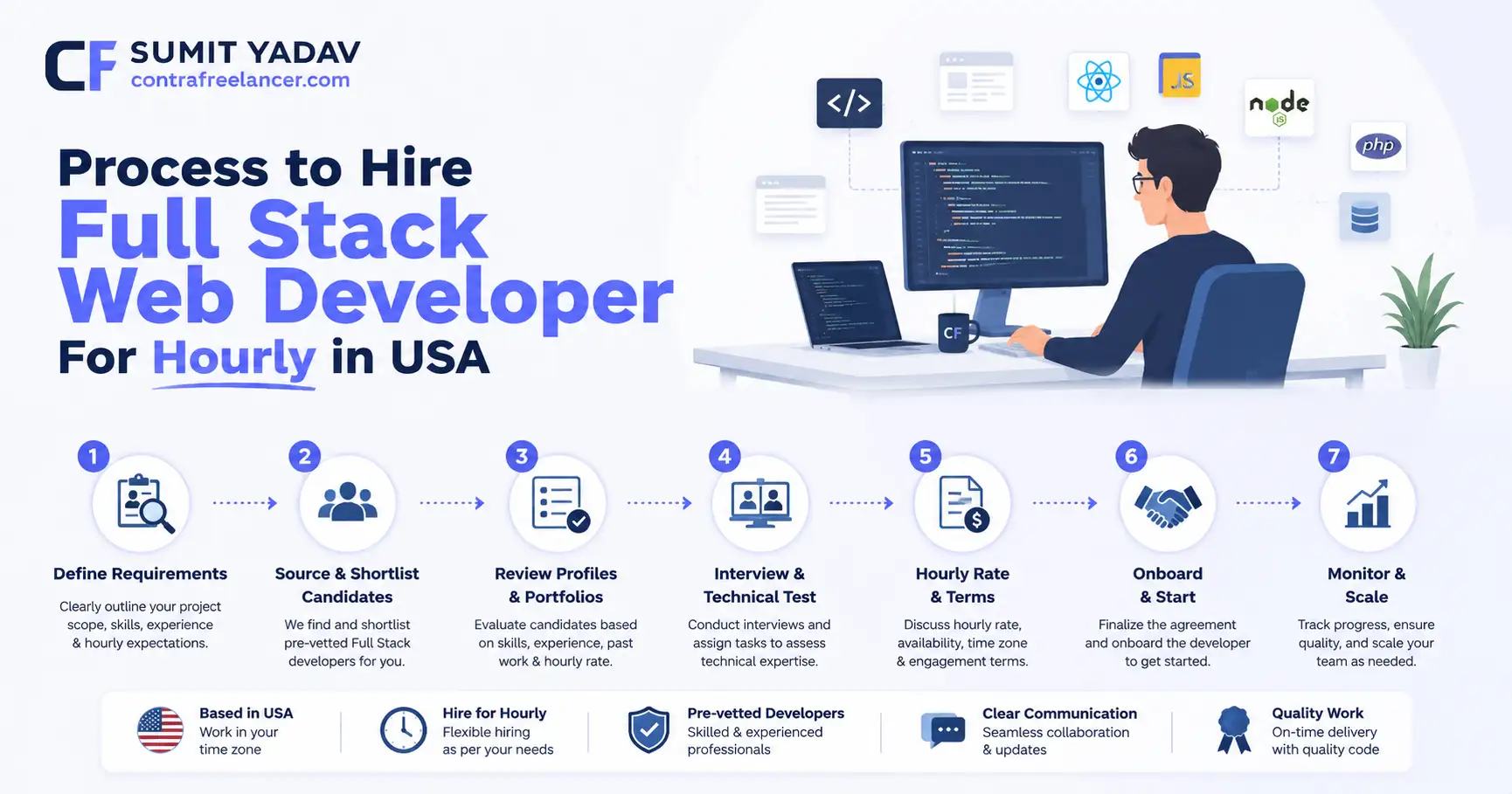
Are you looking to build a powerful web presence but don't want to commit to a full-time salary? You're not alone. Thousands of startups, SMBs, and enterprises across the United States are now choosing to follow a structured process to hire Full Stack Web Developer for hourly in USA to save costs while getting expert-level output. Websites like Contra Freelancer have made it easier than ever to connect with pre-vetted, top-tier full stack developers who bill by the hour giving you complete control over your budget and timeline. In this comprehensive guide, we break down every step of the process to hire Full Stack Web Developer for hourly in USA so you can make confident, informed hiring decisions.
Why the Process to Hire Full Stack Web Developer For Hourly in USA Matters
The traditional model of hiring full-time engineers is expensive, slow, and rigid. When you follow a structured process to hire full stack web developer for hourly in USA, you gain:
• Complete budget control pay only for hours worked
• Flexibility to scale up or down as project demands evolve
• Access to top-tier talent from across the USA
• Faster onboarding compared to traditional hiring
• Transparency through time-tracking and reporting
What Is a Full Stack Web Developer?
A full stack web developer is a tech professional who works on both the front-end (client side) and back-end (server side) of a web application. They are fluent in technologies like HTML, CSS, JavaScript, React, Node.js, Python, databases (MySQL, MongoDB), APIs, and cloud services (AWS, GCP, Azure).
Key Skills to Look For Before You Hire a Full Stack Web Developer For Hourly in USA
Skill Area | Technologies Covered |
|---|---|
Front-End Development | HTML5, CSS3, JavaScript, React.js, Vue.js, Angular |
Back-End Development | Node.js, Python (Django/Flask), Ruby on Rails, PHP |
Database Management | MySQL, PostgreSQL, MongoDB, Firebase |
DevOps & Deployment | AWS, Docker, CI/CD Pipelines, Git, Linux |
APIs & Integrations | REST APIs, GraphQL, Third-Party Integrations |
A strong full stack developer bridges the gap between user experience and server logic, making them one of the most valuable technical hires for any web project.
Why Hire a Full Stack Web Developer For Hourly in USA?
The United States has one of the most vibrant tech ecosystems in the world. When businesses choose to hire a Full Stack Web Developer for hourly in USA, they unlock multiple advantages over traditional full-time hiring:
Flexibility:- You only pay for the hours worked. If your project scope changes and it often does you're not locked into a lump-sum contract.
Cost Efficiency:- Hiring on an hourly basis allows you to scale up or down based on project phases. Sprint heavy? Increase hours. In review? Pull back.
Speed to Market:- Hourly developers can often start within days rather than weeks. You bypass the slow agency procurement cycle entirely.
Transparency:- With time-tracking tools and weekly reports, you always know exactly what was built and when.
Access to Specialized Talent:- The U.S. freelance market is rich with developers who specialize in specific stacks MERN, MEAN, LAMP, and more.
When you're building or upgrading a digital product and need someone who understands both the UI and the database behind it, choosing to hire a full stack web developer for hourly in USA is the smart, agile choice.
Process to Hire Full Stack Web Developer For Hourly in USA
Step 1:- Define Your Project Requirements Clearly
Before you post a job or browse profiles, get laser-focused on what you need. Vague job descriptions attract the wrong candidates and waste everyone's time.
Ask yourself:
What problem am I solving?
What is the expected tech stack?
How many hours per week do I need?
Is this a short project (under 3 months) or ongoing?
Do I need someone available in U.S. time zones?
Write a concise brief that answers these questions. Include any wireframes, design references, or functional specs you already have. The more clarity you provide upfront, the better proposals you'll receive.
Step 2:- Choose the Right Platform to Find Talent
Not all platforms are created equal. Here is a breakdown of where to find vetted, hourly full stack developers in the USA:
Platform | Best For | Commission Model | Vetting Level |
|---|---|---|---|
Toptal | Enterprise-grade developers | High platform fee | Top 3% verified |
Upwork | Wide variety of experience levels | Service fee applies | Community reviews |
Hired | Tech roles, salary & hourly | Employer pays fee | Skill assessments |
Arc.dev | Remote-first U.S. developers | Subscription model | Technical vetting |
Contra Freelancer stands out because it is commission-free for both the freelancer and the client. Developers keep 100% of their rate, which means better-quality professionals are more likely to list their services there. It also supports hourly contracts with built-in invoicing and project tracking.
Step 3:- Write a Compelling Job Post to Hire a Full Stack Web Developer Hourly
Your job post is your first impression. A well-written post attracts experienced developers; a vague one attracts everyone else.
What to include in your job post:
Project title and summary (2–3 sentences)
Tech stack required (e.g., React.js, Node.js, MongoDB)
Hourly rate budget range (be honest — ranges work better than exact figures)
Estimated hours per week and project duration
Communication expectations (daily standup? Async Slack updates?)
Time zone requirements if any
Links to existing product, design mockups, or GitHub repo
Avoid jargon-heavy posts. Write it the way you'd speak to a developer in a meeting — clear, professional, and direct.
When comparing technology choices for your project, understanding the debate between React.js vs WordPress For Business can help you communicate the right requirements to candidates.
Step 4:- Screen Candidates Effectively
Once proposals start coming in, it's time to filter. Here's a structured screening approach:
First Pass - Profile Review:
Years of relevant experience
Portfolio projects (are they similar to yours?)
Hourly rate vs. budget alignment
Client testimonials and ratings
Second Pass - Technical Screening: Send a short technical questionnaire (no longer than 5–10 questions) to shortlisted candidates. Ask about:
Their approach to a specific architecture problem relevant to your project
Experience with your core technologies
How they handle version control, testing, or deployment
Third Pass - Video Interview: A 30-minute call is enough to assess communication skills, cultural fit, and technical depth. Prepare at least 3 technical and 2 situational questions.
Red Flags to Watch For:
Unable to explain past projects clearly
No questions about your product
Refuses to share code samples or GitHub profile
Rate dramatically lower than market without explanation
Step 5:- Evaluate Portfolios and Code Quality
Ask every shortlisted developer to share:
2–3 live projects or GitHub repositories
A code walkthrough (even a 10-minute Loom video works)
References from past U.S.-based clients
Evaluate code for:
Clean structure and comments
Security practices (no hardcoded credentials, proper auth)
Scalability considerations
Test coverage
Many full stack developers who also work as a Custom Responsive Website Developer Freelancer USA will have strong portfolios demonstrating both design responsiveness and back-end integration a sign of well-rounded capability.
Step 6:- Set Hourly Rate Expectations Before Hire a Full Stack Web Developer
Understanding the market rate helps you avoid underpaying (which results in poor quality) or overpaying (which burns your budget unnecessarily).
Experience Level | Hourly Rate Range (USA) | Best For |
|---|---|---|
Junior (0–2 years) | $35 – $65/hr | Small features, bug fixes |
Mid-Level (3–5 years) | $65 – $110/hr | Full product development |
Senior (6–10 years) | $110 – $160/hr | Architecture, complex systems |
Expert / Principal | $160 – $250+/hr | CTO-level consulting, scale |
These rates reflect U.S.-based freelancers in 2024–2025. Developers in high-demand markets (San Francisco, New York, Seattle) may charge at the higher end even for remote work.
Pro Tip: Always agree on a cap for example, "maximum 20 hours per week" to avoid bill shock at the end of your first billing cycle.
Step 7:- Conduct a Paid Trial
Before committing to a long-term engagement, run a short paid trial. This is standard practice and respected in the freelance industry.
A typical paid trial:
Duration: 10–20 hours
Scope: A small, defined feature or task
Goal: Evaluate code quality, communication, and deadline adherence
This trial protects both parties. The developer gets paid for their work, and you get real evidence of what working together looks like.
Step 8:- Define Contract Terms
Even on an hourly basis, you need a clear agreement. Most freelance platforms have built-in contracts, but custom agreements offer more protection.
Your contract should cover:
Hourly rate and billing cycle (weekly or bi-weekly)
Scope of work (what's included and what's out of scope)
IP ownership (you should own all code produced)
Confidentiality/NDA clauses
Revision and feedback process
Termination clause (typically 2 weeks' notice)
Website like Contra Freelancer support structured hourly contracts with automated invoicing, removing the administrative burden entirely.
When deciding your tech stack before writing the contract, many clients find it helpful to explore the Pro & Con of WordPress vs Webflow to confirm what development environment they want their developer working in.
Step 9:- Onboard Your Developer Properly
Poor onboarding is one of the top reasons freelance engagements fail. Even an experienced developer needs context.
Your onboarding checklist:
Share project documentation (PRD, design files, API docs)
Grant access to required tools (GitHub, Jira, Figma, Slack)
Introduce them to any team members they'll collaborate with
Walk through your codebase on a screen-share call
Align on communication cadence (daily check-ins? Weekly sprints?)
Clarify your preferred Git workflow (branching strategy, PR reviews)
A smooth onboarding process typically results in a faster start and a better overall project outcome.
Step 10:- Manage the Engagement Effectively
Hiring the developer is just the beginning. Managing the hourly engagement well is what determines your ROI.
Best practices:
Use sprint-based planning (1–2 week sprints with clear deliverables)
Require time-tracking reports (most platforms offer this automatically)
Review progress at the end of each sprint
Give timely, specific feedback — not vague comments
Adjust hours based on project phase
When evaluating new tooling for your product, understanding the Difference Between Framer and Webflow can help you guide your developer toward the right platform for your front-end requirements.
Who Should Hire a Full Stack Web Developer For Hourly in USA?
Not every business needs a full-time in-house developer. Hourly full stack developers are the right choice for:
Business Type | Why Hourly Makes Sense |
|---|---|
Startups & Bootstrapped Founders | Limited budget; need flexibility |
E-commerce Brands | Ongoing updates, feature additions |
Marketing & Creative Agencies | Client project overflow |
SaaS Companies (Early Stage) | MVP development and iteration |
Enterprise Teams | Augmenting existing dev capacity |
Non-Profits & Educational Orgs | Project-based work within budget |
How Do You Know It's the Right Time to Hire a Full Stack Web Developer Hourly?
If you're unsure whether hourly or fixed-price is better for your situation, consider this: hourly works best when requirements are likely to evolve. Fixed-price is better only when every requirement is locked in before development starts which is rare.
How to Hire a Full Stack Web Developer Hourly in USA - Common Mistakes to Avoid
Even experienced hiring managers make these mistakes:
Mistake 1- Hiring on Rate Alone:- The cheapest developer is rarely the best value. A $50/hr developer who takes 3x as long is more expensive than a $100/hr developer who delivers clean, maintainable code on time.
Mistake 2 - Skipping the technical screen:- References and portfolios matter, but nothing replaces a structured technical assessment.
Mistake 3 - Unclear communication expectations:- Developers need to know how and when to communicate with you. Define this in writing before work begins.
Mistake 4 - No performance checkpoints:- Don't wait until the end of a 3-month engagement to discover the developer wasn't delivering. Set weekly or bi-weekly milestones.
Mistake 5 - Ignoring time zone fit:- A developer in a completely opposite time zone can work but only if you're both aligned on asynchronous communication from the start.
Conclusion
The process to hire full stack web developer for hourly in USA doesn't have to be complicated. With the right preparation clear requirements, a structured screening process, fair market rates, and solid onboarding you can find and retain excellent talent within days, not months.
Website like Contra Freelancer have made it easier than ever to connect with skilled, independent full stack developers without platform commissions eating into either party's budget. Whether you're a startup building an MVP or an enterprise team looking to augment capacity, the hourly model gives you the agility to move fast and build smart.
Start with a detailed brief, screen rigorously, run a paid trial, and invest in a proper onboarding experience. Follow this process and you'll not only find the right developer you'll build a long-term working relationship that scales with your business.
FAQs
Q: What is the average hourly rate to hire a full stack web developer in the USA?
A: Rates typically range from $15/hr for junior developers to $250+/hr for expert-level professionals, depending on skills and experience.
Q: How many hours per week should I expect a freelance full stack developer to work
A: Most hourly freelancers are available for 10–40 hours per week depending on their availability and other commitments.
Q: Is a paid trial necessary before committing to a full stack developer?
A: Yes, a 10–20 hour paid trial is highly recommended to verify skill level, communication quality, and deadline adherence before a longer commitment.
Q: Can I hire a full stack developer part-time on an hourly basis?
A: Absolutely many businesses hire developers for 10–20 hours per week, making it a cost-effective way to build and maintain digital products.
Q: What should I include in a full stack developer job post?
A: Include the tech stack, estimated hours, hourly budget range, project description, time zone requirements, and communication expectations.
Q: How do I verify a full stack developer's skills before hiring?
A: Review their portfolio, conduct a technical questionnaire, request a code walkthrough, and run a short paid trial project to assess real-world capability.
Q: Does Contra Freelancer charge a commission on hourly projects?
A: No, Contra Freelancer is commission-free for both clients and developers, which makes it an attractive option for hourly engagements.
Q: How is hourly hiring different from a fixed-price contract?
A: Hourly hiring offers more flexibility and transparency, billing only for actual time worked, while fixed-price contracts cover a defined scope for a set total fee.
Q: How do I verify if a developer's portfolio is legitimate?
A: Request GitHub repository access, contact previous clients directly, ask specific technical questions about projects, and use code verification tools to assess actual contributions.
Q: How do I handle intellectual property rights with freelancers?
A: Include explicit IP ownership clauses in contracts transferring all work product rights to you. Include provisions for open-source contributions and pre-existing developer code.
Q: Can I hire part-time developers or do they prefer full-time?
A: Many freelancers prefer flexible part-time arrangements. Offer minimum weekly commitments (10-15 hours) for stability while maintaining arrangement flexibility.